MokuToc
Powered by Mokujiro Studio
Demo
Tracking 3I/ATLAS
Field notes on the third interstellar object, from discovery to the last observation.
On 1 July 2025 a survey telescope in Chile logged a faint smudge moving too fast to belong here. Within days the orbit was clear: the object was not bound to the Sun and never had been. It became 3I/ATLAS, the third interstellar object on record. These are field notes on what it was, how it was found and how to follow the next one.
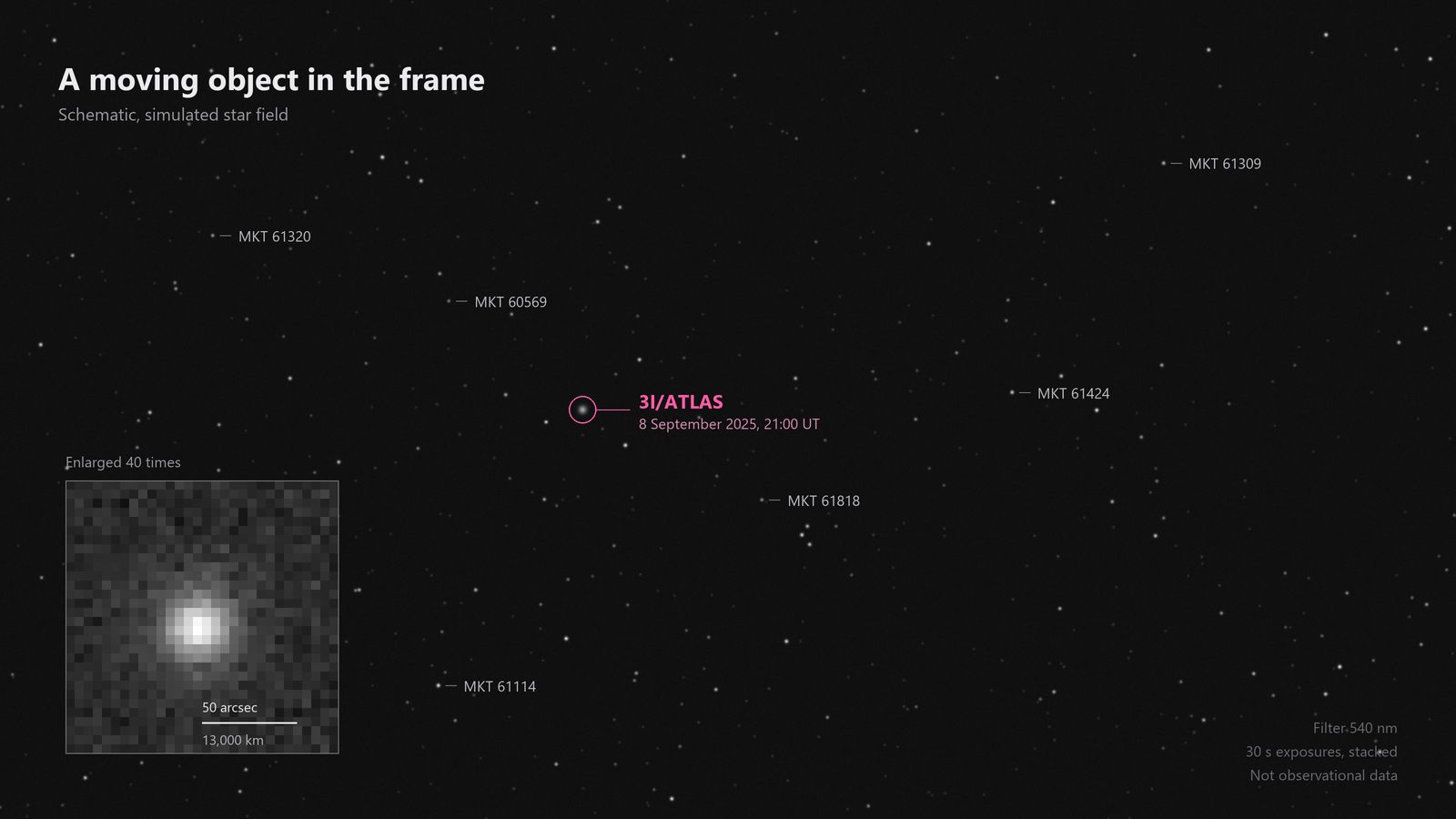
Schematic: one frame from a survey night, with the moving object marked and its coma enlarged
What 3I/ATLAS is
Formally it is C/2025 N1 (ATLAS), classified as a hyperbolic comet. The eccentricity of its orbit is 6.14. Anything above 1 is unbound, so the number tells you the Sun could never have captured this object and will never hold on to it. It arrived from interstellar space, swung through the inner Solar System once and left.
It is also a real comet rather than a bare rock. Sunlight warmed its ices, gas and dust streamed off, and a coma formed around the nucleus. That behaviour is what separates it from the first interstellar visitor.
Three objects in eight years, after two centuries of looking. The rate is not the discovery. The rate is the news.
The three visitors
Each one has been stranger than the last.
Object | Announced | Eccentricity | Perihelion | Type |
|---|---|---|---|---|
1I/'Oumuamua | October 2017 | 1.20 | 0.26 au | No coma |
2I/Borisov | August 2019 | 3.36 | 2.01 au | Comet |
3I/ATLAS | July 2025 | 6.14 | 1.36 au | Comet |
The eccentricity column is the one to watch. A higher number means the object was moving faster when it arrived, and 3I/ATLAS arrived very fast indeed: roughly 210,000 kilometres per hour, the highest velocity ever recorded for a visitor to the Solar System. Speed like that is accumulated over time. Every star and cloud it drifted past gave it a small gravitational nudge, which makes it a reasonable guess that this comet has been travelling for billions of years.
How it was found
The ATLAS survey
The Asteroid Terrestrial-impact Last Alert System sweeps the whole visible sky every night or two, looking for things that move. It was built to catch asteroids on a collision course, so it is tuned for exactly the signature an interstellar object produces: a point of light in the wrong place, then in a slightly different wrong place an hour later. The discovery came at 675 million kilometres from the Sun, out beyond the asteroid belt.
The precovery trail
Once an orbit exists, archives become useful. Astronomers ran the trajectory backwards and found the comet sitting unremarked in images taken as early as 15 May 2025, six weeks before anyone knew to look. Those older positions tightened the orbit far more than new observations could.
What the telescopes saw
From Earth orbit
Hubble took the sharpest picture of the comet then available, in July 2025, and used it to bracket the size of the nucleus. The answer was a range rather than a number: no larger than 5.6 kilometres across, possibly as small as 320 metres. The solid body itself stayed hidden inside its own dust the entire time. What the images did show was a plume lifting off the sunward side and the beginning of a tail behind it.
From Mars
In October the comet passed close enough to Mars that instruments in orbit there could turn away from the planet and study it instead: spacecraft built to map another world, used as telescopes. Ultraviolet spectrographs picked out the comet's hydrogen cloud as a separate smudge, shifted away from the planet's own hydrogen by the speed between them.
Ground based follow up
Gemini North tracked the comet through the second half of 2025 and watched the tail grow. The dust loss rate matched what ordinary comets do at that distance, which was quietly reassuring: an object from another star behaving like the ones from ours. Orbit solutions since have needed a small non-gravitational term, modelled on carbon dioxide driving the outgassing rather than water. The comet was pushing itself, gently, off the path gravity alone would have taken.
The orbit
Plotted against the planets, the path gives itself away. A bound comet traces a closed loop. This one draws a line that enters, bends around the Sun and keeps going.
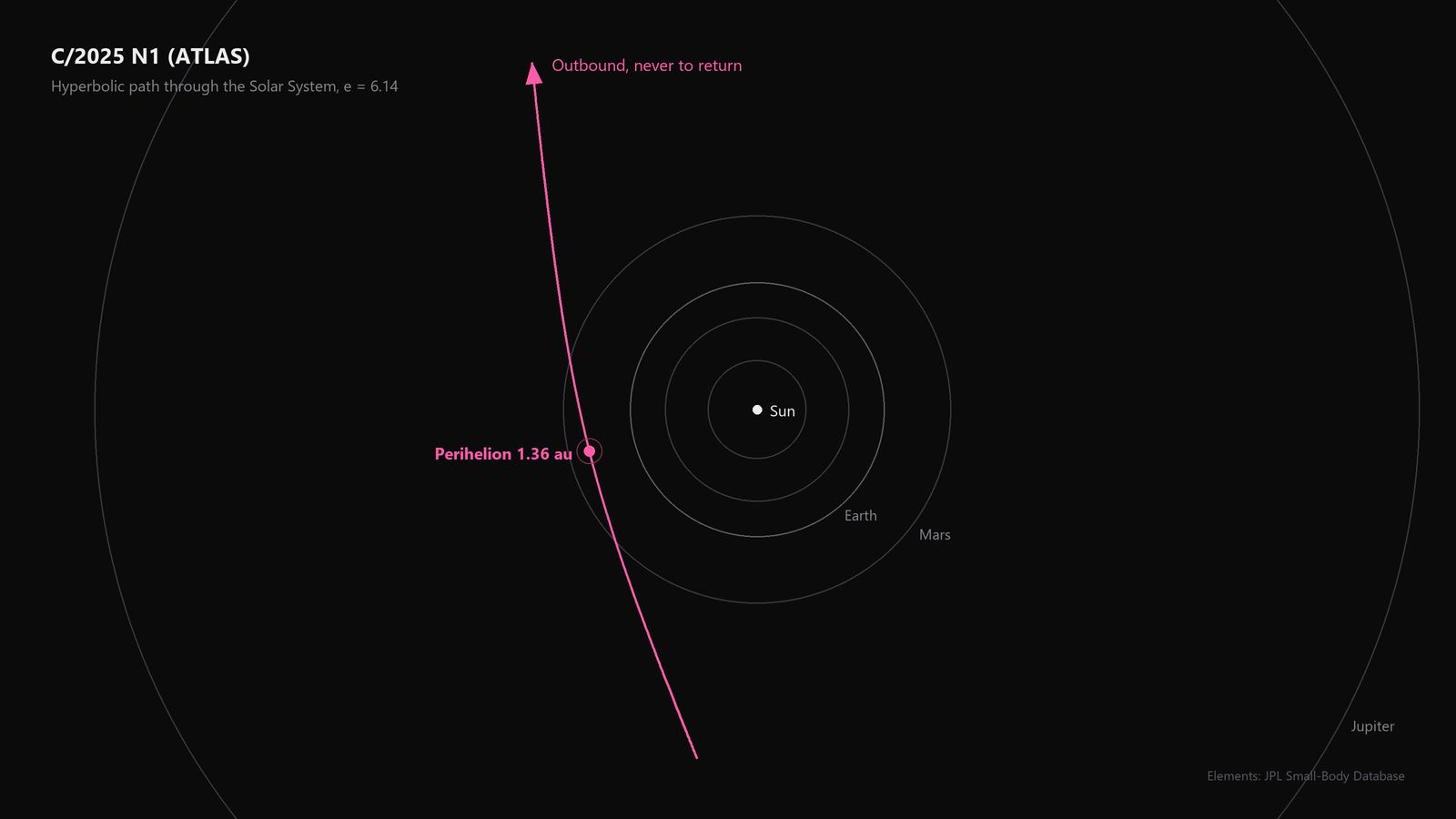
Diagram drawn for this page from the orbital elements in the JPL Small-Body Database. Not an observation.
The current solution rests on 782 observations across an arc of 280 days, the last of them on 19 February 2026.
Reading the elements
An inclination of 175 degrees means the comet travelled almost exactly in the plane of the planets but in the opposite direction, meeting the Solar System head on. Perihelion distance of 1.36 au put its closest approach to the Sun a little inside the orbit of Mars. The two orbits, ours and its, never pass within 0.36 au of each other, so at no point was there anything to worry about.
Timeline
Date | Event |
|---|---|
15 May 2025 | Earliest precovery image, found later in archives |
1 July 2025 | Discovery by ATLAS at 675 million km from the Sun |
7 August 2025 | Hubble size estimate published |
October 2025 | Observed from Mars orbit |
29 October 2025 | Perihelion at 1.36 au |
19 February 2026 | Last observation in the current solution |
Observing notes
3I/ATLAS never became an easy target, and it has since faded beyond the reach of most amateur equipment. The next one might be brighter, so the habits are worth building.
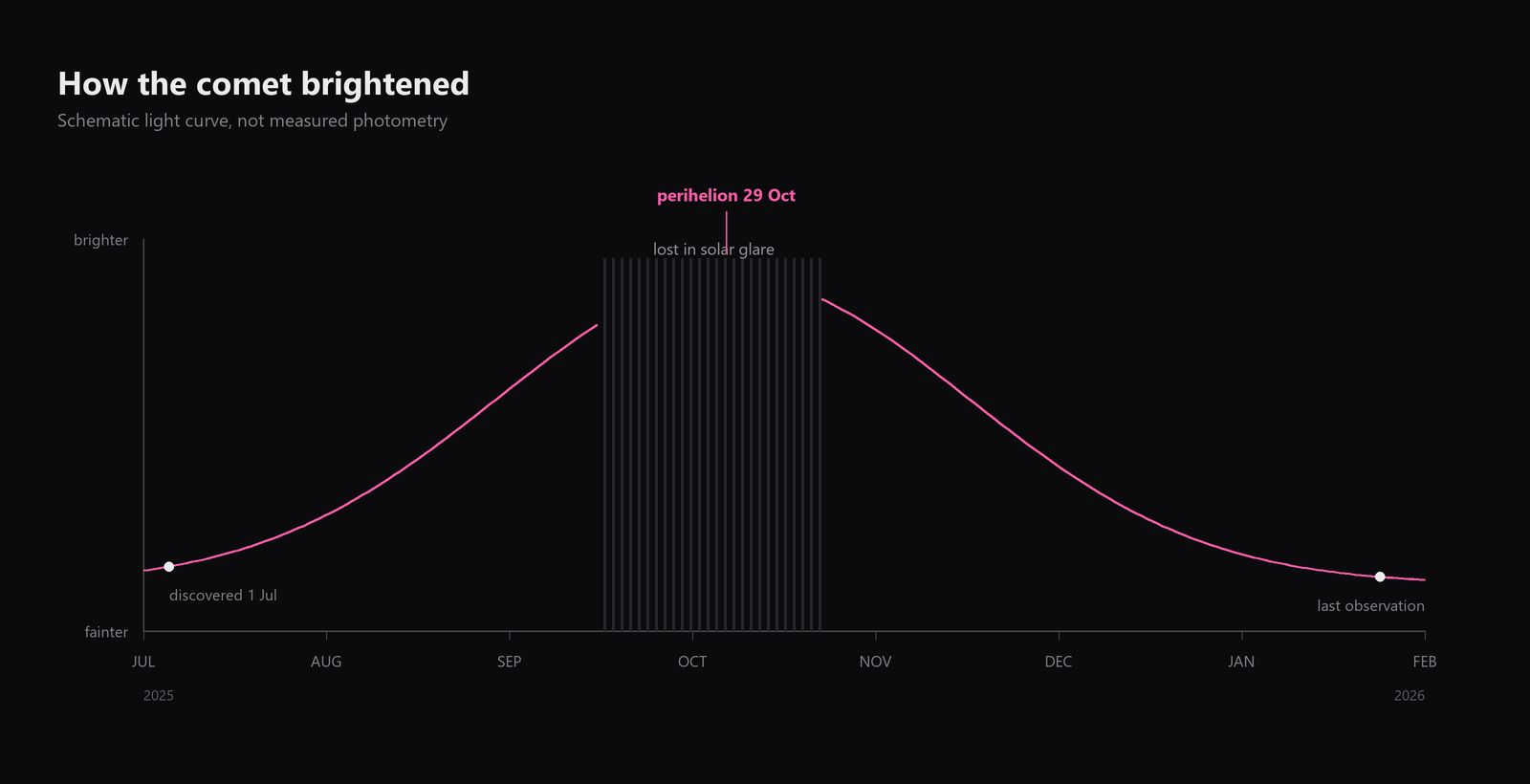
Schematic light curve drawn for this page. It shows the shape of the season, not measured photometry.
Sky conditions
Drive away from city light before spending money on aperture
Avoid the Moon within five days of full
Give your eyes twenty minutes to adapt and protect that with a red torch
Transparency matters more than steadiness for faint fuzzy targets
Equipment
Setup | Rule of thumb |
|---|---|
Binoculars, 10x50 | Only at magnitude 8 or brighter |
200mm telescope | Visual detection to about magnitude 12 |
Tracked camera | Fainter again, and the only way to record a tail |
Remote telescope hire | Southern targets from a northern back yard |
Photographing a fast mover
A comet moving this quickly smears against the stars, so you have a choice to make before the first frame: track the stars and let the comet trail, or track the comet and let the stars trail. Most people shoot both and blend them later.
A starting recipe
Processing
Stack, stretch the histogram in small steps and stop before the background goes grey. A faint comet rendered honestly beats a bright one rendered loudly, and the ion tail usually appears in the version you almost threw away.
Why it matters
Every interstellar object is a sample from another planetary system, delivered free. We cannot visit one yet, but we can read the light coming off it and learn what its home was made of. Three objects is not a population, though it is enough to suggest that the sky is busier than we assumed and that our surveys were simply not sharp enough to notice.
Further reading
The orbit solutions live in the JPL Small-Body Database, updated whenever new observations arrive. Everything on this page was drawn from that record and from the published Hubble measurement of the nucleus.
About this page
Tracking 3I/ATLAS is demo content for MokuToc, a table of contents component for Framer. Facts and orbital elements come from NASA and ESA/Hubble releases on 3I/ATLAS and from the JPL Small-Body Database. All three figures are editorial schematics drawn for this page, not measured imagery. This project is not affiliated with, or endorsed by, NASA, ESA or JPL.